
The Beginning
The Mitoku story begins in 1967 when company founder Akiyoshi Kazama (1930-2012) and Michio Kushi (1926-2014), one of the founder of the macrobiotic movement crossed paths. After spending years spreading the word about macrobiotics, Kushi decided to open a microbiotic store, named Erewhon, in the US city of Boston. He had long been searching for a way to provide the sort of organic, wholesome, and naturally processed foods Japan could offer to his students and others in order to guide them to a more authentic, natural lifestyle. Then, with perfect timing, he met Kazama, who was already involved in the import-export business. The two men then teamed up, combining their respective expertise to build a unique and specialized business. Kazama then founded Mitoku Co., Ltd. in 1969 with a mission to share the very best of Japan’s traditional foods with the world.
What We Do
For over 50 years Mitoku has been dedicated to introducing the world to the richness of Japan’s traditional food culture. With a strong commitment to quality, integrity, and authenticity, we export fine organic and natural foods that embody health, balance, and satisfaction. Working closely with small family businesses and skilled producers who preserve centuries-old traditional methods, we ensure that each product meets our rigorous standards. We currently ship to customers in more than forty countries across Europe, North and South America, Oceania, Asia and beyond. Through our network of importers, distributors, and retailers, we are committed to providing food that our customers can enjoy while having complete peace of mind about safety.
Our Philosophy
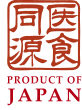
Ishoku Dōgen, this profound Japanese saying has been part of Asian cultural heritage for thousands of years, and it is Mitoku's guiding philosophy. Ishoku means literally “food and medicine”, dōgen “from the same source”. This phrase encapsulates the idea that both that which we eat and that which heals us come from the same source. In other words, our approach to our diet has a great impact on our well-being. Today, modern science and medicine are in agreement with this ancient wisdom. People are increasingly coming to understand the crucial importance of diet to well-being. This is why we are committed to providing products made with the finest organic ingredients available, in partnership with producers who are dedicated to preserving time-honored recipes and traditional preparation methods. When you pick up a Mitoku product, you are being introduced to the spirit of ishoku dōgen – the essence of good food.
Macrobiotics
More than a low fat, sugar and dairy-free, high fiber diet, macrobiotics is a way of life that brings one into balance with nature. It encompasses every facet of life, not simply physical well-being, including an awareness that personal health is influenced by nutrition, fitness, food safety, environmental concerns, spirituality, lifestyle values, and social responsibility. The foods we eat become part of us, and creating balance in each meal can be a practical, positive step toward creating a balance in all aspects of life. Creating balanced meals means choosing foods that are fresh, in season, and of the highest quality. Both scientific research and traditional lore have shown that grain-based diets, which include a variety of vegetables, beans, and sea vegetables, promote balance, health, and vitality. The macrobiotic approach emphasizes choosing healthy foods, that is, foods that are organic whenever possible, non-GMO, sugar-free, and made without the use of preservatives or additives. Unique Japanese foods such as Japanese green tea, kuzu, traditional soy sauce, rice vinegar, umeboshi, and miso are made using traditional methods that preserve and enhance their healthfulness and vitality. Mitoku selects each of our company's foods based on the beliefs and standards of our late founder Akiyoshi Kazama. We have traveled throughout Japan to discover foods that meet the highest macrobiotic standards of quality, both in their ingredients and their production. Mitoku believes in the old Japanese adage, ishoku dōgen, which means "food is medicine". The Mitoku label is your assurance that these traditional foods are of extraordinary quality and are made to promote health and happiness.
-
Mitoku Story: Mitoku and Macrobiotics
MITOKU - Japan's Natural Foods Pioneer
Published in Macrobiotics Today, November/December 2002 (vol. 42, No. 6) By John Belleme
If you are cooking with a high quality, traditional Japanese food that was made in Japan or drink organic green tea that was grown in Japan, there is about an 80% chance it came from Mitoku Company, Ltd., of Tokyo, Japan. This company has profoundly influenced the eating habits of food conscious Americans and has been very influential in setting the manufacturing standards for Japanese natural and macrobiotic foods made in Japan and other parts of the world. However, the statement "made in Japan" has not always been held in such high esteem. In fact, I am old enough to remember when "made in Japan" was a joke.
After the devastation of World War II, Japan reindustrialized with an eye toward export markets in the United States and Europe. However, Japan's early attempts at exporting consumer goods were tacky and not very good quality. About 35 years ago all that changed. Those remarkable transistor radios you could hold in the palm of your hand appeared first, then tiny tape recorders and "tummy TVs". We began trading in our gas guzzlers for fuel efficient Hondas, and before long, Japanese steakhouse chefs were tossing shrimp into the air with spatulas and catching them in plates behind their backs.
The Kushi's timing could not have been better. The philosophy of yin and yang attracted people from many walks of life, including hippies, intellectuals, old Bohemians, and people disillusioned with America's materialistic ways. After lecturing for several years, in 1967, the Kushis founded Erewhon, a small Boston natural foods store supplying macrobiotic students with staples such as grains, beans and other basic foods that are part of the dietary recommendations of the macrobiotic way of life. However, the Kushis soon realized that the quality of food needed was not available in the United States. When Michio Kushi discussed his difficulties with an old university friend, his friend remembered a former schoolmate who was now in the import and export business. He thought his business friend in Tokyo, Japan, might be able to help. That man was Akiyoshi Kazama, the founder of Mitoku.Ironically, about the time Americans and Europeans were warming up to the dazzling array of new high tech consumer goods from Japan, George Ohsawa was roaming the globe preaching his philosophy of yin and yang, an eclectic blend of ancient Shinto, Taoist and Buddhist principles and Oriental medicine, which he called "macrobiotics". In Boston, two of Ohsawa's students, Michio and Tomoko (Aveline) Kushi, were busy teaching macrobiotics to a growing number of students who were drawn to the life changing possibilities of this new way of living.
Kazama's business experience in both the United States and Japan made him a prime candidate for the type of partnership Kushi was looking for. A graduate of Waseda University, in Tokyo, Kazama was selected by Yamanashi perfecture, in 1956, to study business in the United States. After arriving in the Chicago area he was placed with a firm, and to his astonishment, learned that one of his coworkers was none other than Iva Togun, "Tokyo Rose", the infamous voice of Radio Tokyo who taunted allied forces in the Pacific during World War II. His relationship with Iva was short-lived, however, because he was immediately drafted into the American Army and earned the dubious distinction of being the first Japanese national to serve in the United States military after World War II. In the service, Kazama was entrusted with the responsibility for large sums of money.
In the late sixties and early seventies, Mr. Kazama began crisscrossing the Japanese archipelago in an all out effort to supply Erewhon with macrobiotic quality foods. Many early possibilities led to dead ends and frustration; however, there were a few notable exceptions, such as Johsen shoyu, which was naturally aged in twelve-foot-tall cedar tanks for eighteen months and made from whole soybeans and wheat, and dark, rich Hatcho miso, which has been made by the same recipe and method for over eight hundred years! Soon Kazama was joined by Westerners such Blake Rankin, an American, Christopher Dawson, a New Zealander, and Robbie Swinnerton, an Englishman, who helped in the search and export of traditional Japanese foods. By the end of the 1970s, Kazama and the Mitoku band of wandering food detectives had uncovered a virtual cornucopia of rare, flavorful, and medicinal foods, such as long-aged, whole soybean, wheat free tamari; brown rice vinegar that is aged for twelve months in one hundred-year-old earthen jars that are buried in the earth to help regulate the temperature of the delicate fermentation process; kanten and tofu that are freeze-dried in the snow just as it was done before the introduction of electricity; sweet amber mirin made from aging distilled sake and amazake; and natural grain malts with a gentle sweetness that does not overwhelm the taste buds like modern syrups made from enzymes.The association between 39-year-old Kazama and the Kushis was to be a perfect match, for Kazama was both a sharp businessman and a great lover of good food. Although he had never encountered macrobiotics before, as a connoisseur he had made his own discoveries about the best quality foods. Invariably his personal favorites were traditionally made from the finest ingredients and free of high tech processing and chemical additives. Above all he admired those foods that had what he called "spirit". But Japan, like other industrialized countries, had turned away from their traditional dietary roots in favor of mass-produced, highly processed foods with little of the integrity, flavor, or health promoting qualities of the original product. For example, just about all of Japan's important fermented foods, such as shoyu, tamari, miso, rice vinegar and mirin were being made by hurried, high temperature aging and contained highly processed ingredients. Mr. Kazama knew that finding producers willing to meet Kushi's macrobiotic standards would not be easy, but he was inspired by the idea of introducing Americans to the ancient culinary treasures of Japan
Meanwhile, in the United States macrobiotics was booming. Erewhon had grown from a small store to one of the country's largest natural food distributors, delivering Mitoku products down the East Coast to large stores in New York, Philadelphia, Baltimore, and Washington, D.C. Another Erewhon store had opened in Los Angeles and was importing Mitoku products. In the south, Tree of Life was branching out from its home in St. Augustine, Florida, and Westbrae was importing Mitoku products into California and distributing them in the western states. Although more slowly, macrobiotics was spreading on the other side of the Atlantic, with budding communities in the United Kingdom, France, and Belgium. Companies such as Lima in Belgium and Sun Wheel in England were a few of the early importers of Mitoku products in that part of the world.
With macrobiotics catching on around the world, Mitoku's future looked secure, however, everything changes to its opposite, particularly in the world of business and finance. Erewhon was growing so fast that it was soon stretched to the limits of its cash flow and financing capacity and, in 1979, began experiencing financial difficulties. As these troubles worsened, many companies stopped shipping to the Boston firm. Because of a deep personal commitment to the Kushis, Kazama continued to fill orders. When Erewhon finally collapsed in the fall of 1981, Mitoku was its largest creditor and took a three hundred thousand dollar loss.
Erewhon's demise nearly destroyed Mitoku, however, with the help of the foreign and Japanese staff, Kazama nurtured the company back to health. Twenty-two years later, Mitoku is the world's largest exporter of traditional Japanese foods. With more than thirty customers in twenty-two countries, Mitoku exports over five hundred products to firms in North America, South America, Central America, Asia, the Middle East, the United Kingdom, Europe, and Australia. Sales have grown from Erewhon's first order of three thousand dollars in 1968 to over twelve million dollars in 2002. Mitoku is also one of Japan's largest importers and distributors of organic and natural foods from the United States, Canada, and Europe, selling these products along with traditional Japanese products to over ten thousand customers in Japan.
Even after the collapse of Erewhon the personal bond between the Kushis and Mr. Kazama continued to grow as their joint effort to introduce the world to macrobiotic foods moved forward with increasing momentum. Moreover, many of the westerners who came to work for Mitoku in the early years went on to start companies of their own. Christopher Dawson owns Clearspring, Mitoku's largest importer and Europe's foremost distributor of traditional Japanese foods. Blake Rankin went on to start Granum, a Seattle-based Mitoku importer. Bruce Macdonald, who helped open the Erewhon store in Los Angeles, is now the owner, along with daughter Crystal, of Natural Import Company, this country's main distributor of Mitoku brand products.Mitoku's success has transformed the lives of not only Kazama and his family, but, like a pebble dropped into a still pond, Mitoku's influence has had a ripple effect on people and businesses around the world. In Japan small family shops were able to revive ancient food traditions and sell their products at home and abroad. Names such as Johsen, Uchida, Mikawa, Onozaki, Ryujin, and others have become known in natural food stores from Paris to Rio de Janeiro. Moreover, Mitoku producers were introduced to using organic ingredients as Mitoku began importing organic grains and beans for domestic production. (There are very few Japanese organic growers.) As macrobiotics spread, Mitoku products led the way as Kazama rushed to keep up with the ever-increasing needs of the rapidly expanding market. Although demand often surpassed production, Mitoku never wavered from the standards outlined by the Kushis in 1968. Products must be made by traditional methods and recipes, aged at natural temperatures in traditional vessels, and made with organic ingredients, if at all possible.
The history of Mitoku is the story of one man's uncompromising dedication to quality and tradition. When I recently asked Mr. Kazama about the importance of his company in the world natural food movement, he did not talk about how his company raised the standards of natural foods around the world, but rather how Mitoku helped create an opportunity for numerous small Japanese family shops to rediscover their culinary roots and pass this heritage on to future generations. However, from the wider perspective, Michio Kushi has said, "The history of Mitoku Company, Ltd. is a symbol of the history of the macrobiotic movement throughout the world."My wife Jan and I were also profoundly influenced by Kazama and Mitoku. In 1979 we were sent to Japan as part of a joint venture between Oak Feed, a Mitoku importer located in Miami, and Erewhon to make miso in the United States. We met Mr. Kazama in October of that year and he placed us at the Onozaki shop, which is located north of Tokyo. This was the greatest adventure of our lives, and we will be forever grateful to Kazama and Mitoku for the opportunity. We returned to the United States to build Erewhon Miso Company, but when Erewhon went into Chapter 11, the miso project was taken over by Great Eastern Sun, yet another Mitoku importer in Asheville, North Carolina.
Although, at 72, Mr. Kazama looks at the past with gratitude and marvels at the mystery of it all, the future is certainly not clear. As the dollar began to weaken in the eighties, the price of Mitoku products became much more expensive. Soon Japanese foods were being made in other parts of the world at a cheaper price. However, some of these foods are either made by faster, less expensive methods or use lower quality ingredients. Mr. Kazama's goal is to let consumers around the world know there is a difference. When it comes to food, Mitoku has created a whole new meaning for "made in Japan".
-
Mitoku Story 2: Aveline Awards
Mr. and Mrs. Akiyoshi Kazama, founder and president of Mitoku Company, Ltd., were presented with the "Aveline Award" in the first annual "Aveline's Thanking Ceremony" that was held at the Kushi Foundation International Summer Conference on August 6, 2002. Following is the text of the speech given by Mr. Michio Kushi honoring and thanking Mr. and Mrs. Kazama:
Dear Mr. and Mrs. Kazama,
While we were beginning education in Boston, we formed the first natural food company in America, Erewhon, owned by Aveline Kushi, to support natural, healthy lifestyle with macrobiotic principles. At that time, our students and associates were mostly Hippies and Drop-Outs, who were seeking a new vision of the world.
In 1967, through the introduction of our mutual friend, Mr. Obayashi, who was a graduate of Waseda University, we met in Boston to discuss the possible supply from Japan of the best quality of natural food, to be shipped to Erewhon. Dear Mr. and Mrs. Kazama, you both have put enormous efforts to meet our requirements of quality. You searched all over Japan, and inquired at many manufacturers of miso, soy sauce, sea vegetables, umeboshi plums, whole wheat noodles, buckwheat noodles, mochi, and many other products. You chose desirable quality manufacturers of those products, of one kind or another, Erewhon started to import through your Mitoku Company, and you extended liberal credit to our company and later other companies to support our education.
Furthermore, early in the 1970's, together with you, we had meetings at my home in Brookline, Massachusetts, with American natural and macrobiotic food producers and suppliers, such as the Lundbergs, Arrowhead Mills, and several others; and we discussed how to begin the natural and organic food movement, along with dietary practice, in America. These efforts were the beginning of an extensive food and dietary revolution in America. Thereafter, we have been experiencing that this food and dietary revolution has been prevailing throughout North America.
During this period, Mr. and Mrs. Kazama, you extended your kind and sincere guidance to our students and associates during their visits to Japan. These visits were made on many occasions for the purpose of learning the technologies of agriculture, food processing, and security of food quality. Among these visitors were Paul Hawken, Evan Root, John Belleme, Phillip Jannetta, Bruce MacDonald, Christopher Dawson, Norio and Phillip Kushi, and many others.
Also during this period, Dear Mr. and Mrs. Kazama, you have developed and supplied rice hulling machines, utensils and cookware, rice cake machines, and several other pieces of equipment related to food processing. You have made such efforts at the request of Aveline and myself. Despite the fact that the development of the natural food movement made many other non-macrobiotic people and companies enter into this field, which may have tended to degrade quality, you at Mitoku have kept the best quality all the time. Due to such maintenance of quality, lines of Mitoku Macrobiotic products have become symbolic of the health movement.Dear Mr. and Mrs. Kazama, we are grateful to you for your endless cooperation, and you have tried your best to accomplish our requests, satisfying Aveline's Dream. You have talked over the telephone and through fax with Aveline many times throughout this period, perhaps almost every week, discussing how to maintain the best quality of food and cookware and how to develop new products. Furthermore, Mr. and Mrs. Kazama, upon our requests, your supply of the same quality food and equipment began towards the European market. Since the end of the 1970's, together with our intensive lecture tours in every European country, you have supplied products to England, Holland, Belgium, Germany, France, Spain, Portugal, Italy, and Greece, as well as to Scandinavian countries. Furthermore, as our macrobiotic international education spread to South America, Australia, and Asian countries, your products have also gone to these countries.
There has now arisen awareness throughout the world about food quality. Such consciousness is now covering all domains of society, especially among intellectuals. Medical societies, alternative healthcare people, government, and public wellness movements are making the latter 20th century and the early 21st century the dramatic turning point of the history of mankind. All this worldwide trend would not have been realized, and shall not be accomplished, without your understanding, dedication, and cooperation with Aveline and many other macrobiotic and natural food associates and friends throughout the world. Without Mr. and Mrs. Kazama, the world would have been still in Darkness. People's health still would have no Hope. And the future of the world would have no Shining Light. Together with uncountable millions of people, we deeply extend our appreciation to you, Mr. and Mrs. Kazama.
Our education has also influenced the new approach to health through recovery from chronic diseases, such as cancer, heart disease, diabetes, arthritis, and many others. People have recovered from emotional disorders, psychological anxiety, and distress through the practice of macrobiotic and natural lifestyle, with proper eating. Without Mitoku products, these recoveries could not have been realized. Though many millions may not know Mr. and Mrs. Kazama directly in person, their current and future peaceful minds, energetic health, and happy families are profoundly influenced by your products.
Tonight with some 300 friends who have gathered on the occasion of the Kushi Institute's 18th Annual Summer International Macrobiotic Conference, I am honored that the Avelines' Memorial event of the Kushi Foundation is giving you this humble token as "Aveline's Thanking Award." Aveline has been a Pioneer, Innovator, Protector and Guardian as the Mother of the macrobiotic, natural, and organic food movement in Western countries. And she has been, along with her children and all members of her family, as well as her associates, students, and friends, endlessly extending a "Thanks" to you, Dear Mr. and Mrs. Kazama.
Thank you very much again. Our Dream for Mankind, and our appreciation for you, shall continue beyond our lives, forever.
In Peace and Love, Michio Kushi
From our president
Mitoku is a pioneer in the organic foods sector in Japan, having introduced traditional Japanese foods to over 40 countries worldwide and importing organic foods and cosmetics into Japan from 12 countries. Using our accumulated expertise in all things organic, we now handle a wide range of products as a specialist organic trader, from traditional foods and processed items to haircare and skincare products. More recently, we have also become involved in helping to improve the working environment for traditional food producers. These producers are facing serious issues such as the struggle to pass their skills down to the next generation and the various challenges of food craftsmanship. At Mitoku, we consider the creation and expansion of sales channels, both across Japan and internationally, to be an important mission for our company. This is our small contribution to ensuring that traditional production methods can survive. We are now in an age of food abundance, meaning that each of us needs to constantly evaluate the true nature of our ever-changing food landscape. The Japanese market is being impacted by a declining birthrate and aging population, while international markets are seeing continued population growth, particularly among emerging nations. Politics, economies, and societies are experiencing agitation and upheaval at a worldwide level, and Japanese companies also need to be capable of timely and appropriate responses from a global perspective. Going forward, our primary motivation will be to continue to promote traditional Japanese foods that meet global standards in countries around the world, and to introduce exceptional products from leading organic nations to the Japanese market. We will continue to aim for sustainable growth as a company by promoting and distributing top quality products throughout Japan and beyond.
Toyofumi Yoshida, President
Our services
Mitoku handles numerous products, mainly organic Japanese foods, and ships them to businesses abroad. We provide a wide range of services as follows, to help clients and producers to tackle business boundaries and complex overseas exports with our expertise as a specialist of exporting organic products. Our support includes PB packaging and product development, through close collaboration with producers to ensure quality control and meet customers’ needs. When PB packaging is required, we assist with packaging formats, materials, quantities, and regulatory compliance. We also provide agency services to support producers with organic export preparation, documentation, and logistics, while our quality assurance specialists (PCQI certified) help both customers and producers ensure regulatory compliance and maintain high standards of quality control.

Awards
Japanese Government Honors Mitoku for Contribution to Food Exports
We are delighted to announce that Mitoku has been awarded the Minister of Agriculture, Forestry, and Fisheries Prize at the 5th Awards for Excellence in Exports.
This award is intended to shine a light on organizations and individuals involved in the export of Japanese foods. By recognizing their contributions, the Ministry hopes to increase awareness, deepen understanding of Japanese food culture overseas, and cultivate demand for Japanese food exports.
The Ministry chose to award this honor to Mitoku in recognition of our various contributions to the Japanese food industry, such as our long-standing commitment to the export of organic foods; our focus on traditional products, in particular fermented foods, made using time-honored methods; and our support of small-scale producers that would not otherwise have access to overseas distribution channels.
Mitoku president, Mr. Toyofumi Yoshida, was officially presented with the award on December 11th, 2020. The ceremony, held at Capitol Hotel Tokyu, was attended by high-ranking dignitaries including Prime Minister Yoshihide Suga and Mr. Kotaro Nogami, minister for agriculture, forestry, and fisheries.
In his acceptance speech, President Yoshida remarked: “In our modern age, information can travel around the world in an instant. However, traditional food producers still face many challenges when it comes to shipping overseas. Our role has been to help these producers overcome such barriers by offering extensive support in the provision of internationally compliant materials and packaging, training, logistics, marketing, and other areas. In this way, we aim to protect our nation’s rich culinary heritage by promoting traditional Japanese foods around the world.”
We are proud to receive such recognition at the highest level, and look forward to pursuing our mission—spreading awareness of Japan’s culinary treasures—with renewed vigor.
Other Business Activities
Apart from exporting authentic organic Japanese foods, our business also includes import and distribution of premium organic food products (with Organic Jas certification) made from top-quality ingredients. For more information, please visit mitoku.co.jp/en.
